Beach Fishing
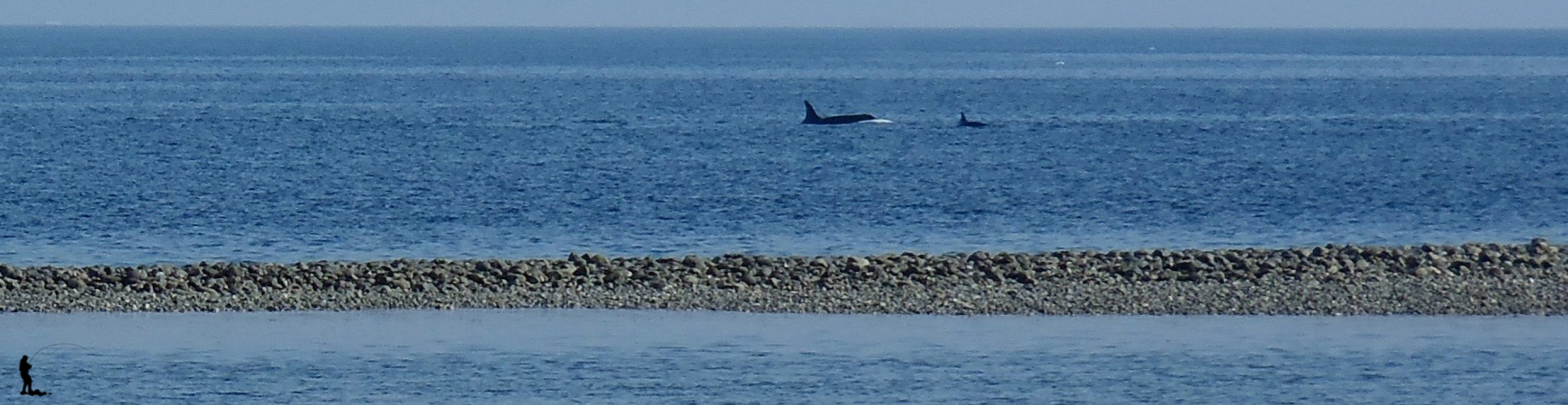
Nature is full of surprises; it provides great stories and hours of reminiscing about the day’s adventures with your friends. One year, a friend of mine, Ian Forbes, and I were fishing outside a gravel spit near Qualicum Beach. A spit is a parcel of gravel exposed as dry land on a low tide but away from the main beach. That day, we were chasing Coho Salmon. We waded to our waist outside the spit and cast lures to stage salmon 200 feet off the shore. It was a great location, as we caught and landed four Coho, with several more hooked and lost. With all the excitement of successful fishing, we lost track of time, and the ocean was coming in fast behind us. We could have been stranded if we had stayed too long. As we crossed the tidewater that had gone around the spit, we turned to look back at where we had been fishing only moments before. There were three Orcas in the exact spot we had been wading. They were hunting their prey, whether it was salmon or seals, and we watched nature at its purest.
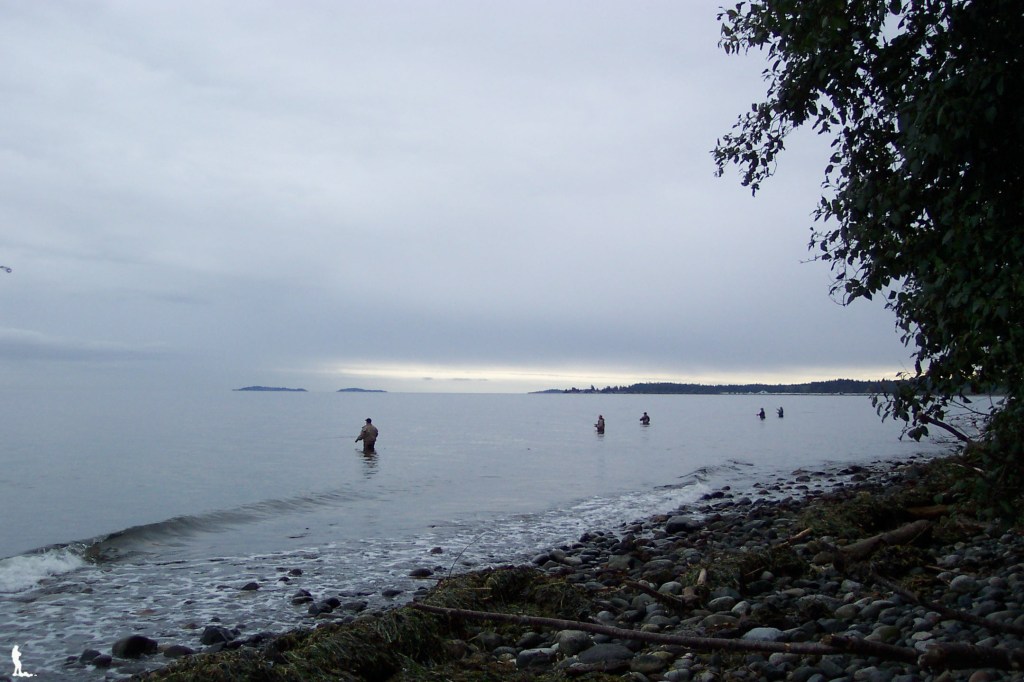
We are very fortunate to have this special salmon fishery on our beaches. It is accessible to all genders and ages, and anglers can fish with flies or use gear to catch these beautiful creatures. Four species can be caught from shore: the pink (Humpy), the spring (Chinook), the coho and the chum salmon. Fishermen start scanning the beaches near the end of July for pink Salmon. By the end of August, spring salmon move close to shore, and the coho Salmon appear toward the end of September. The chum Salmon are the last to arrive in October.
Finding our beaches is no problem; the challenge is finding the salmon. Every year, the salmon will stage on different beaches. Experience is important for successful fishing. The local fishing stores are often a great resource for information on what tackle is successful and where to find the hot spots. Online fishing forums, local magazines, and fishing clubs provide valuable information and expert advice.
Another valuable tool for future reference is your logbook or fishing diary. In the diary, you can review your notes and maps of previous successes or failures. A GPS (Global Positioning System) is useful for providing an exact reference.
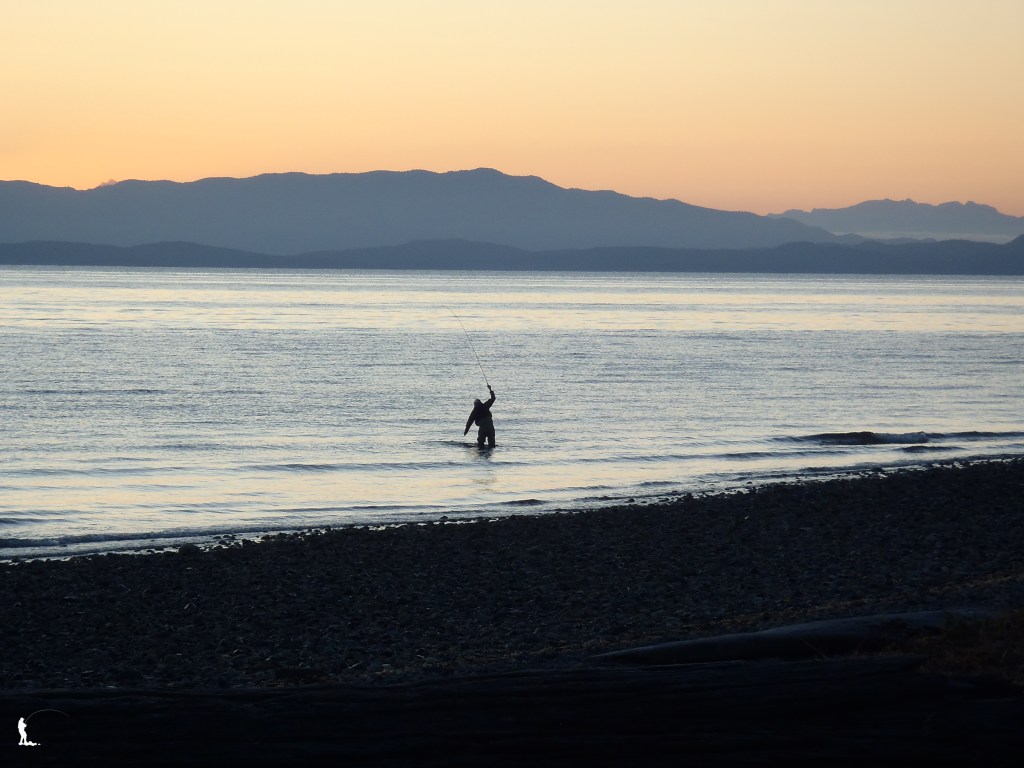
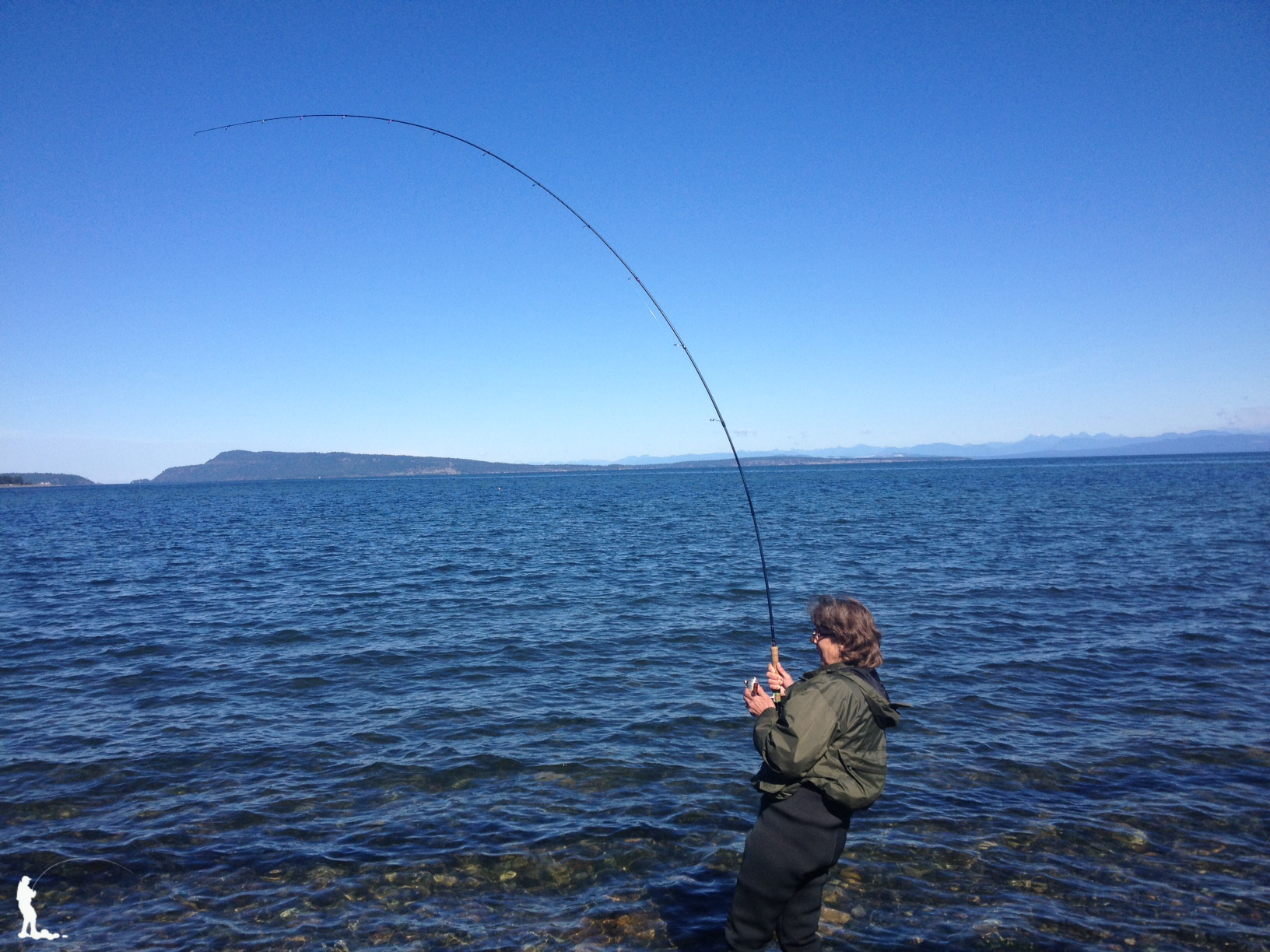
Salmon fishing on our beaches has become increasingly popular and is experiencing exponential growth. One of the biggest changes in this fishery is the length of the fishing rod. The benefit of the long rod is the ability to cover (cast) longer distances and reach fish that are often out of reach for most beach fishermen. We fish on the East coast of Vancouver Island, where the weather is frequently unkind, with strong winds, high surfs and floating debris on tide changes. The fish is sometimes 200 feet or more offshore and beyond most casters.
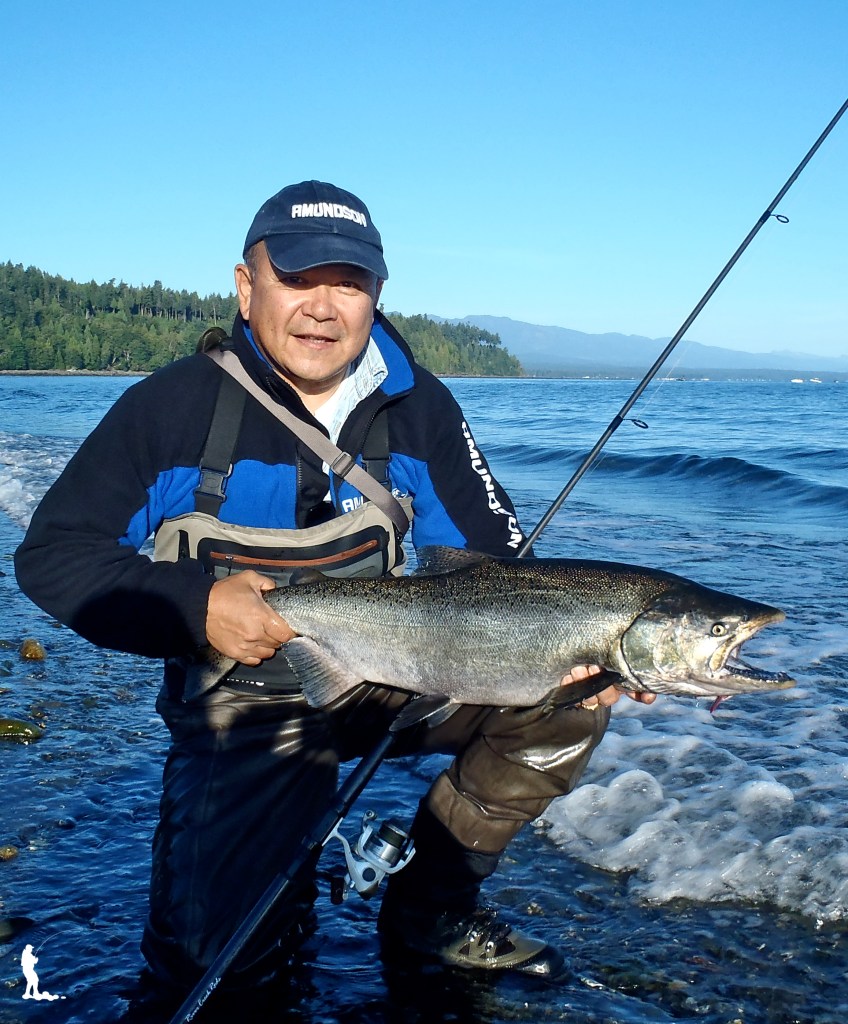
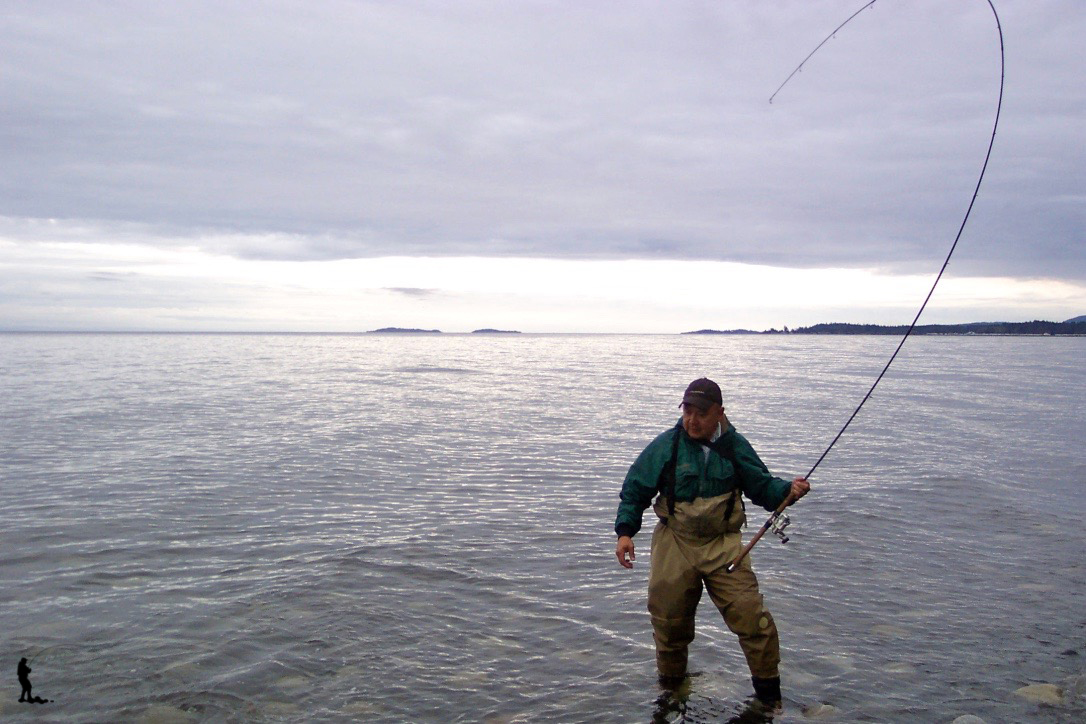
Whether fly-fishing or gear fishing, the rods have been consistently getting longer. The two-handed (fly) switch rods average 12 to 13 feet, and the ultra-light spin-casting long rods range from eleven to fourteen feet. The spinning rods I use are 13 or 13 1/2 feet long. When choosing a spinning rod, consider the weight of the lures for the targeted fish’s size. The weight of the lure will affect the flexibility of the rod. Advancements in technology have allowed rods to become very light, thin, and with increased power.
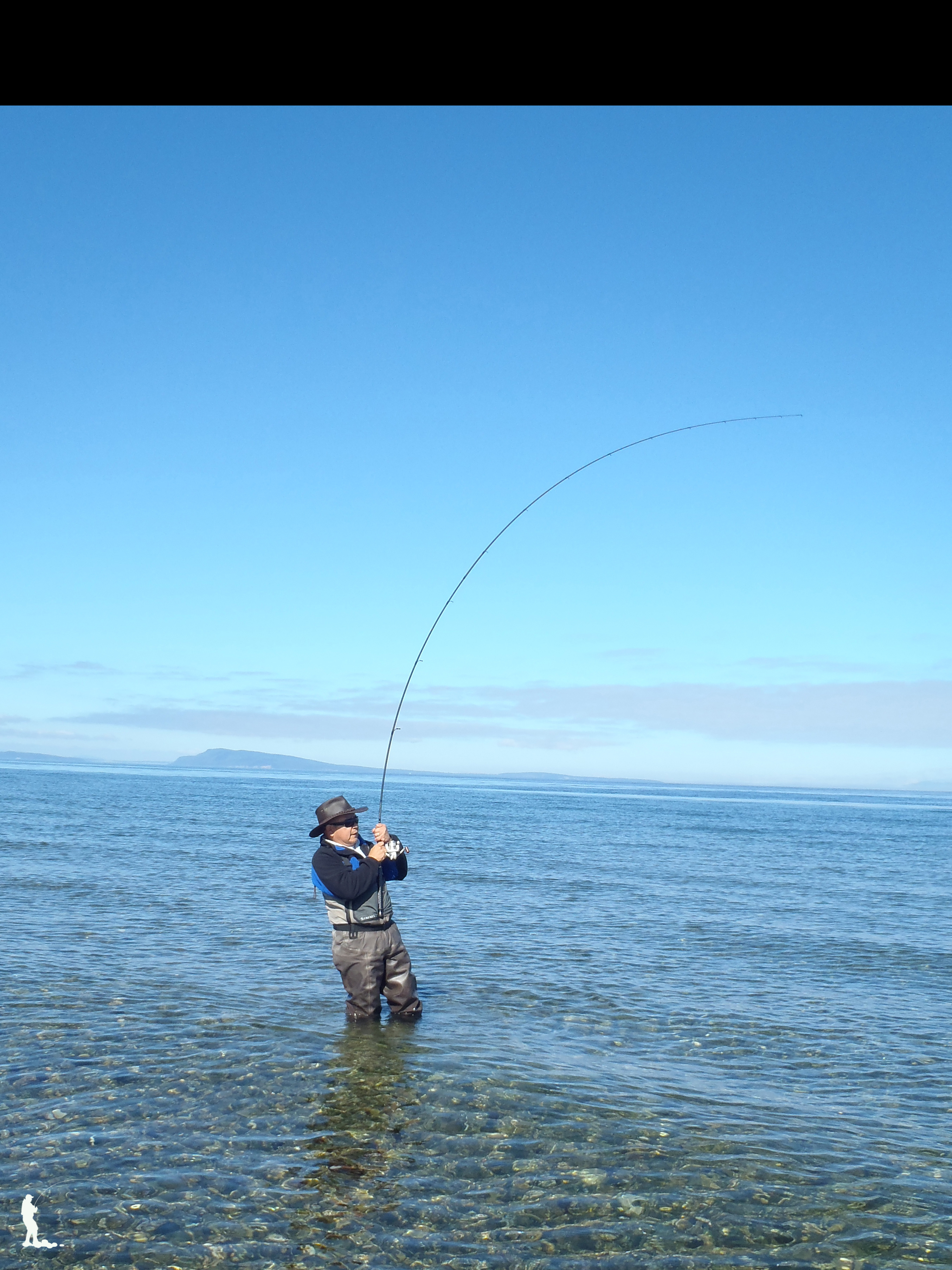
I normally use 1/4 to 3/8 oz. Lures require a very flexible rod that will cast a long distance. Each manufacturer will have the line weight and lure weight classification clearly labelled on their rods. The long spin casting rods used on our beaches have tremendous results, overcoming the obstacles that the shorter rods face. The most common models will have a 6 to 10 lb. line rating for weights ranging from 1/4 oz. to 3/8 oz. Lures.
These long rods should be balanced with an ultra-light reel with a smooth drag. The line capacity on the reel should be about 6 lb./170 yards, 8 lb./120 yards, or 10 lb/100 yards, and the reel should weigh around 9.5oz. Having spare reel spools loaded with different line weights is a must. A good gear ratio is 6:1, with well-made, sealed bearings.
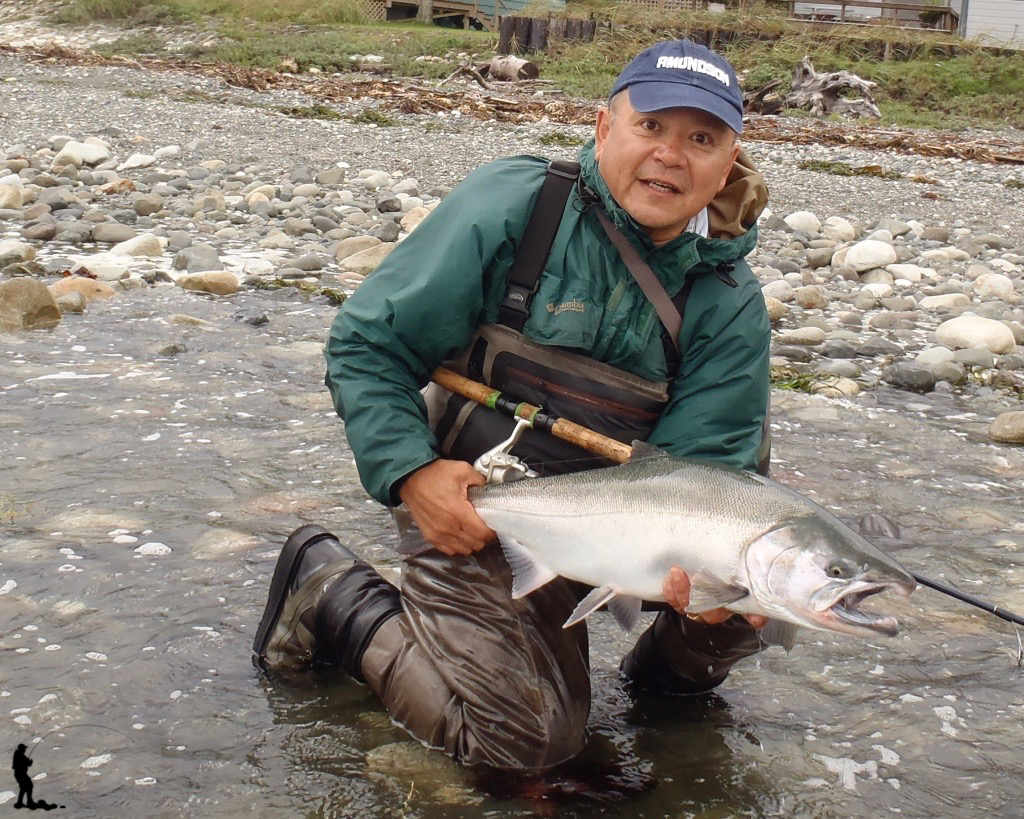
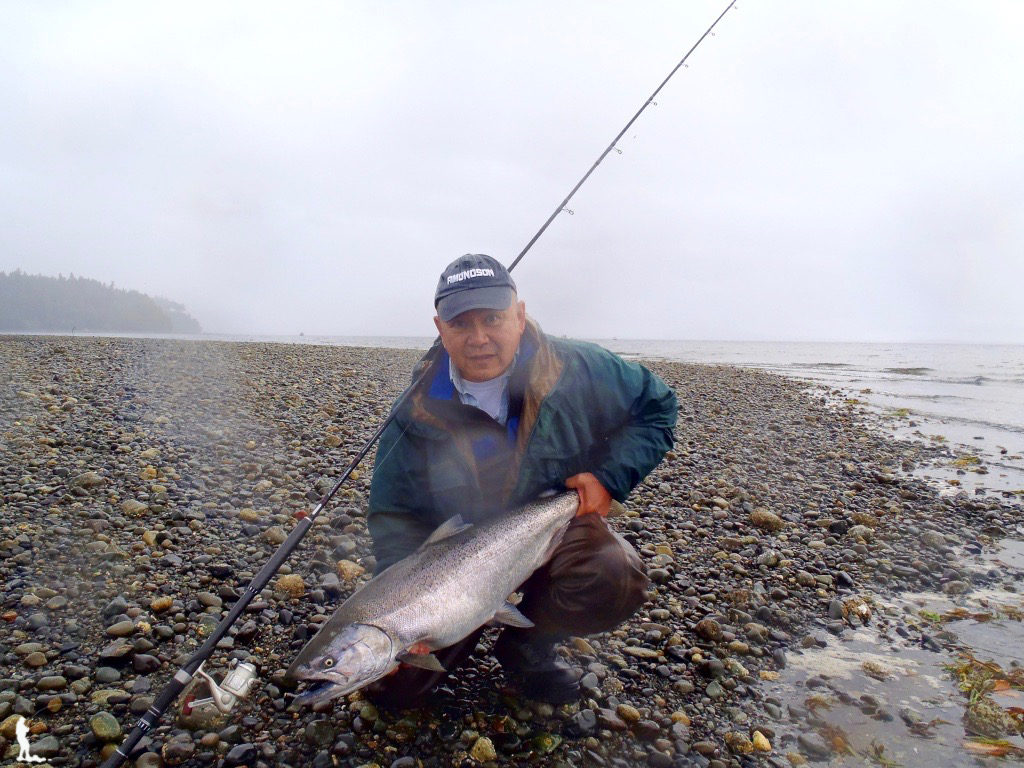
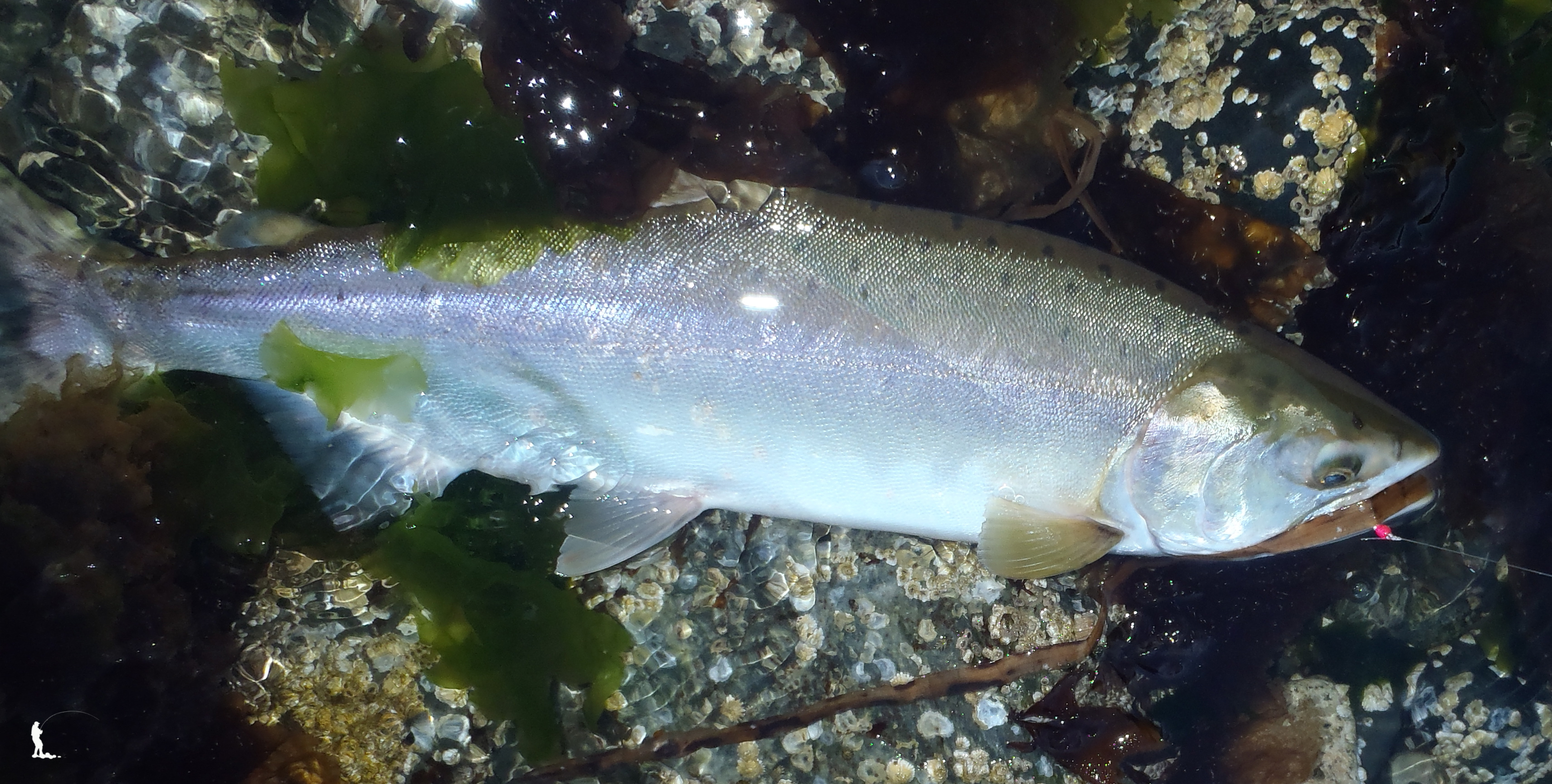
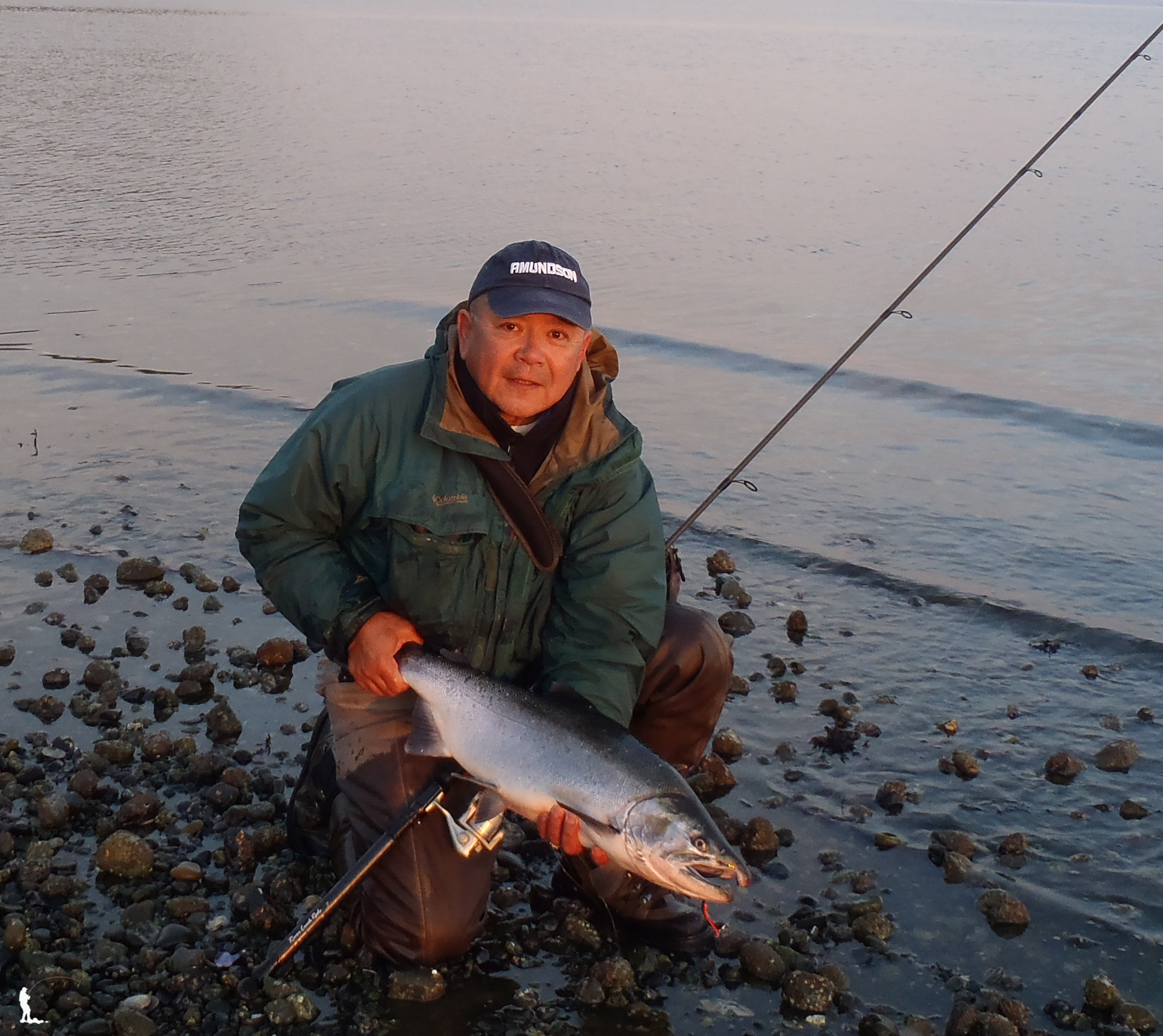
My personal record this year is landing a 22-pound, 1/4-ounce fish. Spring Salmon on an eight-pound monofilament line. One issue while playing with these large salmon is that they often panic when their belly touches the gravel as you try to land them. They can still be 10 feet or more away from dry land. Gravity is now your nemesis. Their size and weight are now detrimental to the 8-pound line. Many rods and lines are currently broken. It helps to have a fishing partner to help reel in the salmon and assist in landing and controlling your trophy. Salmon that are to be released should not be hauled onto the gravel. Take a firm grip on the tail and quickly slip the barbless hook from the jaw with forceps or pliers.

For the spin fisherman, line diameter affects the length of the cast. A thin diameter line casts further than a thick diameter line when using the same lure weight. The diameter will relate to the type of fishing line being used. Manufacturers discuss line strength, limpness, memory resistance, abrasion resistance, and visibility. They seldom talk about line diameter unless they are marketing leaders. This is where a micrometre comes in handy. The smaller the diameter of the line, the more you can spool on the reel.
Three types of tensions occur when retrieving the line after casts of 200 feet or more. First, the line is spooled loose when picking up the slack line after the cast. Next, retrieving the lure will allow the line to be spooled with medium tension. Finally, the line will be spooled with firm tension when fighting a salmon. The various tensions on the spool, combined with the constant twisting of the line that occurs with spinning reels, can play havoc with some fishing lines. Constant reeling, when a salmon is pulling line off the reel, will cause automatic line twists. The proper technique is to pump the rod upward while using the reel drag for tension, and then reel in line when lowering the rod. Always maintain firm, even tension when playing large fish, and never allow slack line.
There are various types of fishing lines: monofilament, braid, fluorocarbon, and copolymer.
Monofilament is the most commonly used line. It can be found in all weight and diameter classes. Monofilament is less expensive than other lines and can have a considerable stretch that will vary depending on the quality and manufacturer of the line. A good quality line is limp, offers low memory, and has good abrasion resistance. Monofilament offers reasonable knot strength and is easy to cast. Using a lightweight line of 6 or 8 Lb tests, I often replace the first half of the spooled line after every third outing. Monofilament on spinning reels tends to twist and get abrasion damage after landing several salmon. Manufacturers produce monofilament in various diameters for the same pound test rating. I favour a line diameter of 0.011, allowing for the maximum load on my small, ultra-light reel.
The braid or Spider Wire lines have smaller diameters and increased weight strength. They are considerably thinner than the monofilament, and you can load a reel with 30 to 50% more lines. Initially, braided lines are easy to cast; they have no memory and are limp. However, they are prone to creating bird nest knots from the constant twisting of a spinning reel. Due to the various retrieval tensions, the line will start to dig into itself when heavy tension is applied. This reduces the success of your casts. The line coming off a spinning reel is loose, and a braided line will eventually coil into knots. When fishing under freezing temperatures, these lines hold water and will easily freeze, making casting difficult.
The Fluorocarbon line, whether pure or coated, is considerably less visible. It sinks faster and has the same weight-to-diameter ratio as the monofilament line. However, the stiffness and memory can cause havoc with an ultra-light spinning reel. I found fluorocarbon to be perfect for the leader but not for the main casting line on an ultra-light spinning reel. A level wind reel, or a bait caster, is better suited for fluorocarbon or braided lines because it comes off the reel straight without coiling.
In comparison, the copolymer lines are thicker and more abrasion-resistant. The copolymer line is best suited for casting or trolling with heavy tackle and a large-level wind reel. It is ideal for large fish such as Halibut, Grouper, and Sailfish.
I typically use an 8-pound monofilament line for my main line, with an additional 3 to 4 feet of 12-pound full fluorocarbon line as my leader. The two lines are connected with a well-lubricated surgeon knot. Always thoroughly test a knot before using it.
On the East coast of Vancouver Island, beach fishermen often carry a variety of lengths and weights of spoons, spinners, jigs and soft body lures. Lures will range in length from 1 1/2 inches to 5 inches. Their weight can vary from 1/4 oz. to 3/4 oz. The most popular are the lures that flutter like wounded fish. Early in the season, the salmon can’t resist them. My favourite colours are brass with an orange stripe, all brass, silver, Rainbow Trout colours and green mixed like a Perch. The wind can become very strong, and casting against it can be difficult. That is when to use Zingers and Buzz Bomb lures that can cut through heavy wind gusts to reach their target.
Occasionally, the salmon get what is called lockjaw. They have seen a lot of hardware and tend to ignore it. They are concluding their staging process and entering spawning mode. Currently, spinning lures are more productive. A spinning lure can get an aggressive strike despite the salmon shutting down their feeding habits. A spinner will not achieve the long distances other lures obtain, but the salmon are usually closer to shore at the end of the season. Cast on top of the school, allowing the lure to flutter as it sinks. Wait a few seconds and slowly retrieve the spinner. If I don’t get a strike within the first twenty feet, I bring it in quickly for another cast. A salmon will often follow the spinner right to the rod tip.
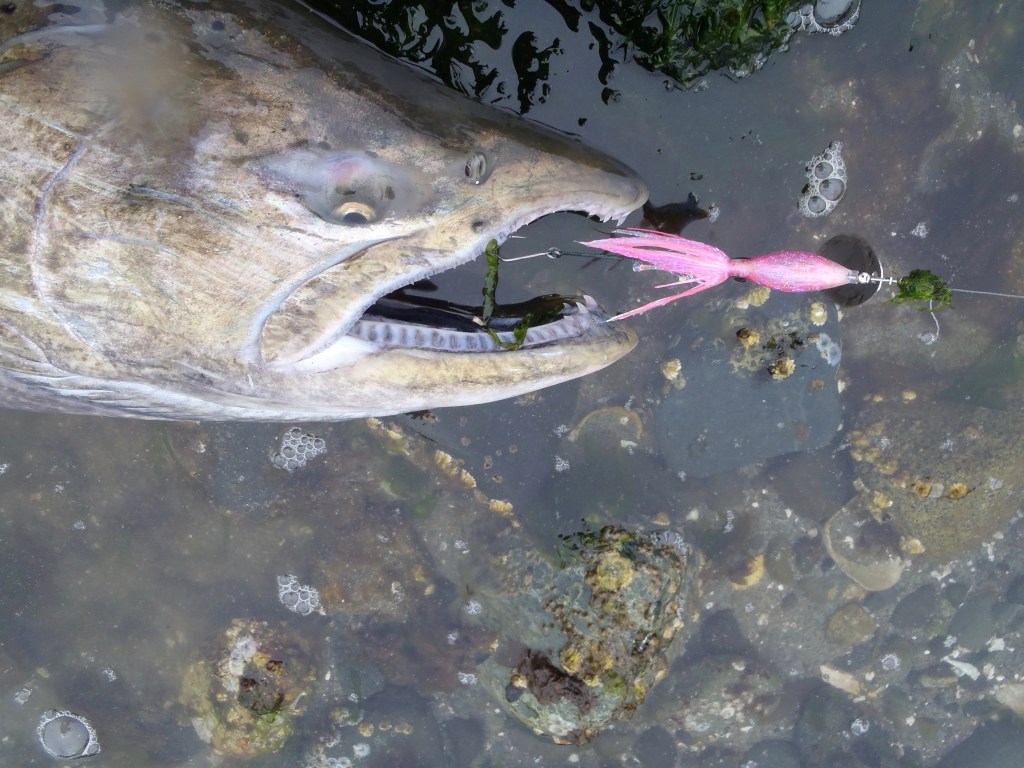
The short strike is frustrating while fishing for salmon from a beach. You get the strike, a very short fight, or a couple of headshakes, and then they are gone. My theory is they didn’t fully commit to biting the lure. What a friend has done, and I have since adopted, is to remove the manufacturer’s hook and split ring off the lure. We replaced it with a sickle hook attached to a one-inch braided Dacron line. The hook trails further back, achieving a more swaying action. This causes less stress on the hook and can’t be twisted out when the Coho are jumping and rolling. The result has been extremely positive, with hook sets and a few deeply hooked fish. It also allows easier hook removal from salmon meant for release.
The ocean is cold, and often neoprene waders are used for their insulating qualities. However, neoprene can be uncomfortable during hot weather when not in the water. Breathable waders are a better option on hot days. They are lighter and release excess body heat. Air molecules are smaller than water molecules and pass through the wader’s membrane. Breathable waders require layered clothing for insulation and to wick moisture away from the body. Wading boots must be durable and provide good ankle support. They will be exposed to barnacles, sharp edges, weeds, boulders, and slippery terrain.
The beach angler is a sight fisherman and rarely casts blindly. They wait until they find the salmon before fishing for it. More time is spent searching than actually fishing. Once the salmon are found, it’s important not to rush into the water. Fish senses are astute and will scatter if they feel your vibrations. Move slowly and smoothly.
There will be times when the salmon cannot be easily seen. Binoculars are another important tool for beach fishing. They allow you to scan far distances and identify the signs of salmon in the area. The water will move. Differently, dorsal or tail fins might be exposed, bait surfacing, salmon jumping, or you can see them swimming through high waves.
Whether casting to a single fish or a school, the objective is to cast over and beyond them, bringing the lure through the school. Another technique is to cast beyond a moving school ahead of them and reel across their path. Both techniques work and will attract salmon to your lure. Occasionally, and very often in the case of Pink salmon, the school will be so dense that it is more productive to cast to the edge of the school. Salmon within the school cannot even see your lure.
When a salmon is hooked, try to pull it away from the school. You want to minimize disturbance so that it doesn’t affect your chances of catching more salmon. When the fishing is slow, I listen to the rhythmic sound of the waves crashing against the beach. The waves caressing the pebbles against each other as they race up and down the beach are almost musical. Exploring the beaches for that perfect fishing location is peaceful and tranquil, allowing you to forget the day’s challenges and enjoy the wonders of nature.
“Make the change and reap the rewards.
Discover more from castingaline.ca
Subscribe to get the latest posts sent to your email.


Very insightful, thank you so much for sharing.
LikeLiked by 1 person