Gil d’Oliveira
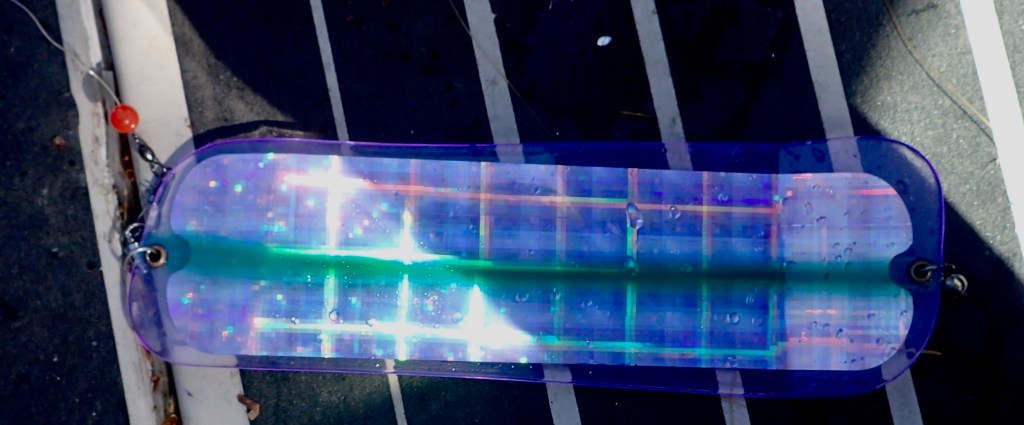
Traditional flashers are 8-11 inches, with slightly tapered boards with opposite bends at each end, causing them to sway back and forth and rotate. A lure that trails behind this motion has erratic action due to the sway. Each side of the flasher has a colour and a reflective surface design. The type of lure, like spoons, bait, hootchies etc., determines the leader’s length to transmit the proper action. A non-action lure like a hootchie or a Bucktail will have a more erratic and wider action path with a flasher using a shorter leader.
To find their prey, salmon use different sensing mechanisms. These sensors detect nerve pulses from baitfish by detecting their sight, smell, sound, and vibration. It is their lateral line that plays the most significant role. Salmon have rows of nerve cells along their sides and heads, allowing them to detect vibrations in the water.
Pro Tip
The single flasher has a narrow end and a wide end. It’s the narrow end of the flasher attached to the main line for optimal results.
Traditional in-line flashers only provide one angle of reflection. The salmon can’t see any reflection when they are not at the right angle of the reflection of the flasher blade. So I believe the sensory of sight is diminished, reducing the optimal drawing ability towards the salmon.
To successfully draw salmon’s attention far away, you need to increase the number of flashers and their flexibility to cover 360-degree reflection coverage with your lure. Moreover, you will experience an exponential increase in sight, sound, and vibration.

Gord Fitzsimmons – Prince Rupert, BC. Wigglefin’s library
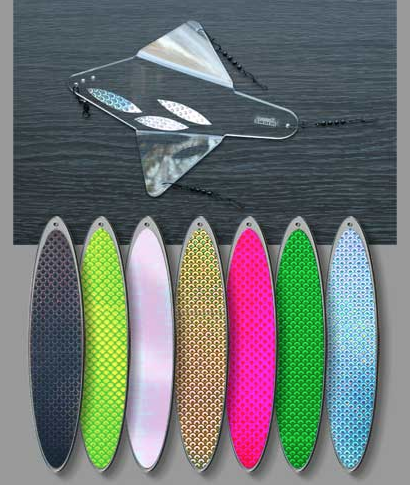
Blades on the Wigglefin Swarm flashers are attached to a bead chain, which allows them to move individually, freely and randomly. By rotating the blades, reflected light can be cast in multiple directions as the flasher is trolled.
When you increase the number of flashers with your lure, the angler increases sight, sounds and vibrations exponentially to draw the attention of salmon far in the distance.
Pro Tip
When using these multi-flasher systems, it is important to balance the boat using a set on each downrigger so that the downward trolling lines remain equally spaced when the boat turns, or trolling depth changes occur.
Normally it comes down to the individual anglers’ past success with their preferred flash system.
I have had success with the Wigglefin Swarm Switchblade flasher system. Each set has nine reflective surfaces within a combined assembled shorter length than its competitors have. The benefit of a shorter system is fewer issues of tangles when lowering the downrigger, less drag and a more dense vibration and flash. The flashing blades are individual, so changing individual blades to other colour options is easier and less time-consuming.
With CrossLoc snaps on the blades of Swarm flashers, you can mix and match blade colours without even taking it off the downrigger, much less changing flashers altogether and re-gearing up.
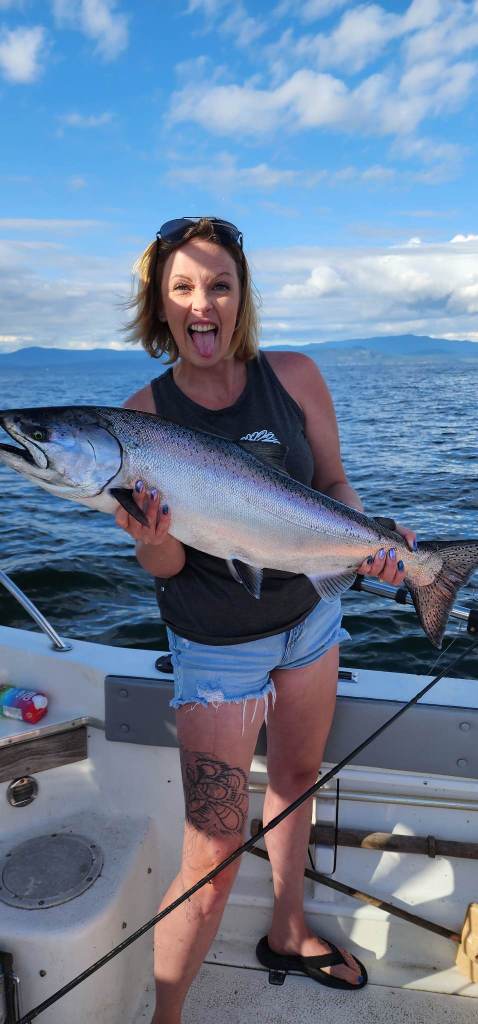
Shannon Mcdougall, Bigfish Charter Tyler Kaye owner and guide, using Swarm flashers at 227 feet deep.

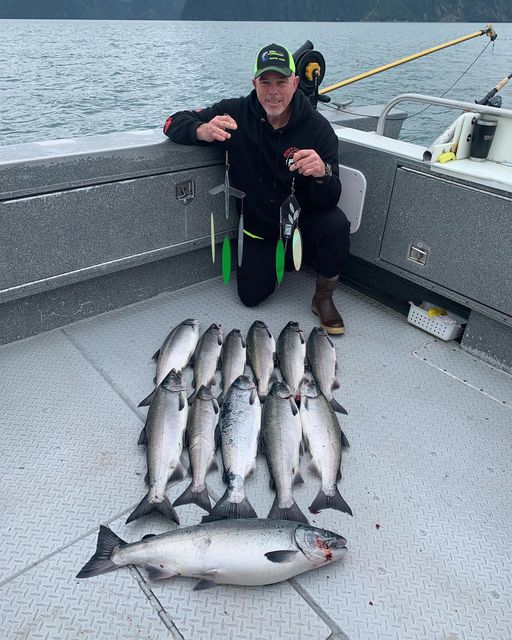
My preference is to use this system as a dummy flasher system. That is having your trolling lure 5-10 feet above and trailing an average of 10-12 feet behind the flasher system. The dummy flasher setup is the best to have the mighty salmon and the angler dual-ling mono to mono on who will win. Salmon will cautiously trail the flasher systems as they are predators but can be wary. The instinct competitor strike is created by the Wigglefin Swarm flasher to the bait (lure) trailing behind the flasher bait ball, striking at it before one of their competitors can consume it.
An angler can fish a lure without a flasher attached to the line when using a dummy flasher setup, which is a great advantage for large Chinook and Coho salmon. Considering how fast and agile they are, I think the salmon will have a much greater chance of leveraging the hook out of its mouth if they are dragging a flasher with a barbless hook through the water. My salmon lines seldom carry flashers. I prefer to run a dummy flasher when fishing for these powerhouses.
Pro Tip
It’s common for the GPS to display the correct speed, but it could be in error when determining the flasher’s performance trolling against or with tide changes. To troll with a downrigger and a 15-pound canon ball, the general rule is that the angler wants the arm and line to have a 45-degree angle for optimal performance. Remember that coho responds better to faster trolling speeds, while Chinook prefers slower ones. The speed range is expected to be between 1.5 and 3.5 miles per hour.
SWARM Switch-Blade Flasher System
Blowback
Your weight and downrigger are separated by a distance or a trolling angle called a blowback. Downriggers create it by pulling weights and lines through the water behind your boat and encountering resistance from the water. If you have 100 feet of line out without blowback, the bait should be at a depth of 100 feet. Consequently, from trolling the blowback, the weight will rise higher in the water column due to the resistance and could be at a depth of 80 feet.


Consequently, the resistance to the blowback is also dictated by whether the trolling direction is against or with the current. So traditionally, old school, for a 15-pound cannonball, the angler wants 45-50 degrees on the downrigger line.
Why not increase your catch rate using a multi-flasher system creating your own bait ball, the Swarm Switchblade Flasher system.
Discover more from castingaline.ca
Subscribe to get the latest posts sent to your email.

